Technical detail
Key Formulation Factors for Transglutaminase
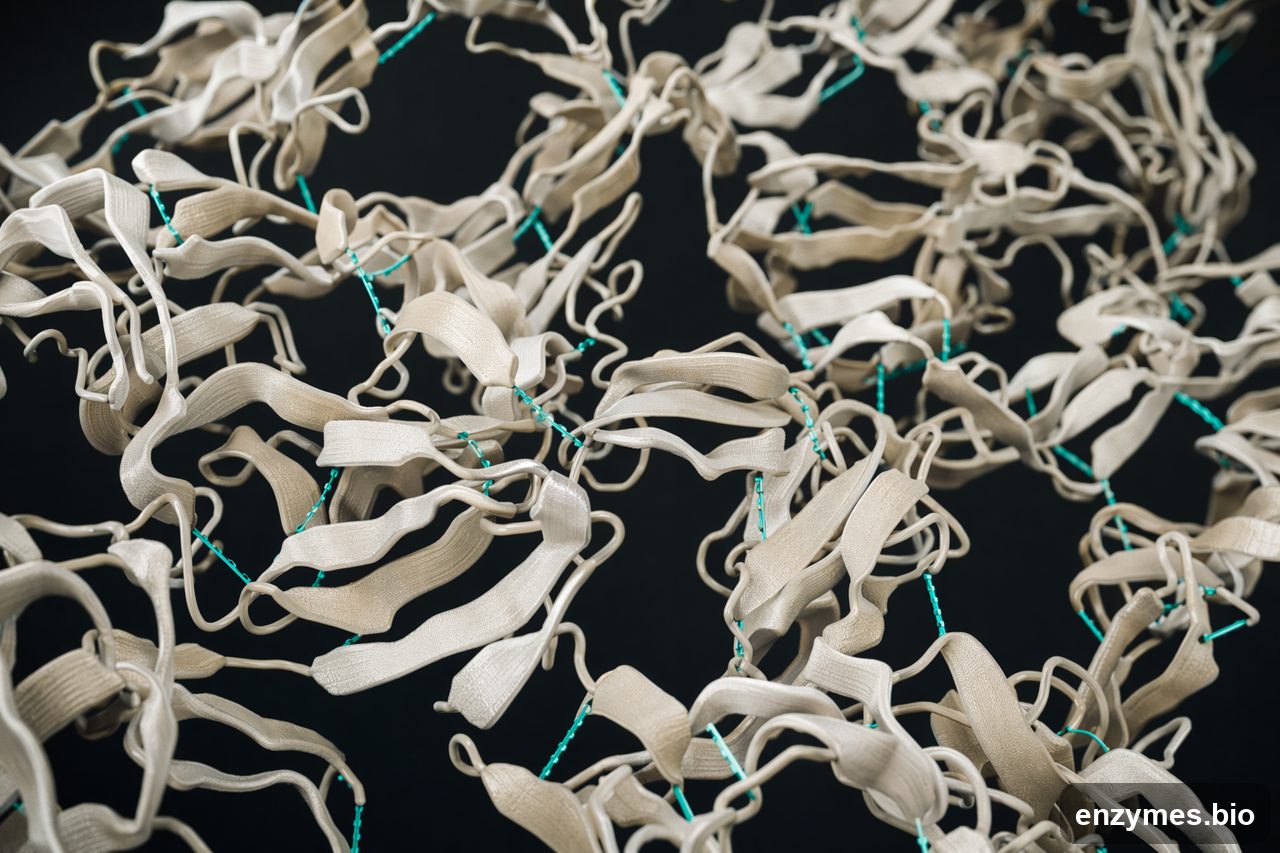
Transglutaminase, also known as protein-glutamine gamma-glutamyltransferase, is a protein-structuring enzyme used to build stronger, more cohesive food matrices. In practical terms, it helps create covalent links between compatible protein sites, improving bite, sliceability, water retention, binding strength, and yield.
But transglutaminase is not a universal texture switch. Its performance depends on the full formulation architecture: which proteins are present, how accessible they are, how water and salt are balanced, how the enzyme is dispersed, and what thermal profile follows.
This guide is written for R&D, procurement, and innovation teams evaluating transglutaminase in meat, seafood, dairy, plant-based, and hybrid protein systems.
Wholesale and bulk transglutaminase for food manufacturers, ingredient blenders, distributors and resellers. Every order is quoted individually. Request a quote with your product or application, the quantity you need and the destination country.
1. Protein substrate: the first performance gate
Transglutaminase requires suitable protein sites to create crosslinks. A formulation rich in protein is not automatically a good substrate. What matters is whether reactive glutamine and lysine residues are present and available.
Strong candidates often include
- Myofibrillar proteins in meat and seafood systems
- Casein-rich dairy matrices
- Soy, pea, wheat, and other plant proteins when sufficiently hydrated and exposed
- Blended animal-plant protein systems designed for binding and structure
Watch-outs
- Highly denatured proteins may behave differently depending on how unfolding affects access
- Insoluble or poorly hydrated proteins can limit reaction efficiency
- Excess fat, starch, fiber, or particulates can dilute protein-to-protein contact
- Protein blends may need different hydration and mixing logic than single-protein systems
A good substrate strategy starts with a simple question: are the right proteins close enough, mobile enough, and accessible enough to be linked?
2. Protein accessibility and pre-processing
The same protein can perform differently depending on pre-processing. Grinding, chopping, homogenization, hydration, shear, salt extraction, and thermal history all change protein exposure.
For meat and seafood, sufficient extraction and surface exposure are often essential for strong binding. For plant proteins, hydration quality and particle dispersion can determine whether transglutaminase reaches the functional protein sites or reacts only at the surface.
Practical formulation checks
- Are proteins fully hydrated before enzyme addition?
- Is the protein phase continuous, or interrupted by fat, fiber, starch, or air?
- Does the process create enough surface area without damaging the final bite?
- Are powders pre-blended to avoid localized enzyme concentration?
In many systems, the enzyme is not the limiting factor. Protein access is.
3. Moisture: enough mobility, not so much dilution
Water supports protein mobility and enzyme distribution. Too little moisture can restrict diffusion and produce weak or uneven binding. Too much moisture can dilute proteins, reduce contact density, and make the final matrix loose.
The target is not maximum water. The target is functional water: moisture that supports protein movement, dispersion, and contact while still allowing the network to consolidate.
Moisture-sensitive applications
- Restructured meat and seafood portions
- High-moisture plant-based formats
- Dairy gels and cultured systems
- Emulsified sausages and hybrid proteins
- Protein-rich fillings or formed components
If water is increased for yield, the protein system often needs additional structure design: salt balance, binders, mixing energy, resting time, and thermal setting must work together.
4. Salt, minerals, and ionic strength
Salt can support protein extraction and functional binding, especially in meat and seafood systems. But ionic strength also affects protein solubility, water binding, and matrix behavior.
Salt can help when it
- Improves extraction of functional proteins
- Increases protein surface availability
- Supports cohesive texture before and during setting
Salt can create issues when it
- Pushes the system toward excessive softness or purge
- Interacts poorly with plant proteins or hydrocolloids
- Changes emulsion stability or dairy gel behavior
- Conflicts with sodium-reduction targets
Low-sodium reformulation should not be treated as a simple salt subtraction. It changes the protein environment. Transglutaminase can be part of the solution, but the system may require rebalancing of protein type, hydration, mixing, and thermal process.
5. pH: protein charge controls proximity
pH influences protein charge, solubility, unfolding, and aggregation. These effects shape how proteins approach one another and how the final network forms.
Near certain protein-specific transition zones, systems may become more prone to aggregation, syneresis, or brittleness. Away from those zones, proteins may remain more dispersed but less likely to build a firm network without process support.
What to evaluate
- Starting pH of the full formula, not just the protein slurry
- pH drift during fermentation, curing, marination, or storage
- Acidulants, cultures, phosphates, and mineral salts
- Heat treatment after enzyme reaction
- Final sensory target: elastic, firm, sliceable, creamy, or fibrous
The best pH is application-specific. It is the point where enzyme performance, protein functionality, and finished texture overlap.
6. Temperature: reaction speed versus process control
Temperature affects reaction rate, protein mobility, and microbial control strategy. Warmer conditions can accelerate structure development, but they can also reduce processing margin if the matrix sets too quickly or unevenly.
Cold or chilled processes may offer better handling control, though they typically require more attention to contact time, mixing, and dispersion.
Temperature planning should consider
- Enzyme addition point
- Time before forming, filling, or packaging
- Resting or holding stage
- Thermal kill or cook step
- Whether heat is used to stop enzyme action and set the final matrix
For commercial scale-up, temperature uniformity is as important as target temperature. Cold spots, warm pockets, and slow transfers can create inconsistent binding.
7. Contact time: structure develops before the final set
Transglutaminase needs time in contact with accessible proteins. Too little time can underbuild texture. Too much time may create excessive firmness, rubberiness, or handling changes before forming.
The right contact time depends on substrate, temperature, enzyme format, mixing intensity, moisture, salt, and desired final bite.
Signs contact time is too short
- Weak seam strength or poor piece-to-piece binding
- Low slice integrity
- Excess purge after cooking or chilling
- Fragile texture during handling
Signs contact time is too long
- Overly firm or elastic bite
- Reduced juiciness perception
- Difficult forming, pumping, or filling
- Texture drift during storage before cooking
Contact time should be validated in the actual process sequence, not only in bench cups.
8. Mixing and dispersion: avoid local overbuilding
Uniform distribution is critical. If transglutaminase is not dispersed evenly, some areas may overbuild while other zones remain weak.
Good dispersion practice
- Pre-blend dry ingredients where appropriate
- Add enzyme at a point where distribution is reliable but exposure time is controlled
- Avoid dumping concentrated enzyme directly into low-mobility masses
- Match mixing energy to the matrix: enough to distribute, not enough to damage structure
- Confirm uniformity in formed, filled, or laminated products
For premium texture targets, distribution quality often separates acceptable trials from production-ready systems.
9. Fat, starch, fiber, and hydrocolloids
Non-protein components can support or obstruct transglutaminase performance. They affect water location, protein contact, viscosity, emulsion stability, and final bite.
Fat
Fat can improve succulence and mouthfeel, but excessive or poorly emulsified fat can interrupt the protein network.
Starch
Starch can bind water and contribute body, but it may compete for hydration and change heat-set texture.
Fiber
Fiber can add structure and nutrition, yet high levels may physically separate proteins or increase water demand.
Hydrocolloids
Hydrocolloids can stabilize water and improve processing tolerance. Used poorly, they can create a gel that reduces protein mobility before crosslinking develops.
Transglutaminase works best when supporting ingredients are selected as part of the protein architecture, not layered on after the fact.
10. Thermal processing and enzyme stop point
Heat affects both the enzyme and the protein matrix. In many applications, a controlled heat step is used after the reaction phase to set texture, support food safety objectives, and stabilize finished structure.
The sequence matters:
- Hydrate and expose proteins
- Disperse enzyme uniformly
- Allow controlled reaction time
- Form, fill, bind, or hold as needed
- Apply thermal process to set the matrix and stop further enzyme-driven change
If heat comes too early, structure may not fully develop. If heat comes too late, texture may continue moving beyond the target. Scale-up should confirm the thermal profile at the coldest and slowest-moving points of the product.
11. Application-specific formulation priorities
Meat and poultry
Focus on protein extraction, salt strategy, moisture control, piece contact, and post-forming hold. Transglutaminase can improve binding, sliceability, reduced purge, and portion integrity.
Seafood
Prioritize gentle handling, surface contact, chilled process control, and moisture management. The opportunity is clean binding without harsh mechanical compression.
Dairy
Evaluate casein system, pH, mineral balance, heat history, and desired gel character. Transglutaminase can support firmness, creaminess, water retention, and reduced syneresis.
Plant-based foods
Design around protein hydration, particle size, blend compatibility, salt level, and fat distribution. Transglutaminase can help move plant matrices from crumbly or pasty toward cohesive, cuttable, and fibrous.
Hybrid protein systems
Use transglutaminase to connect animal and plant protein phases into a more unified matrix. The main work is balancing hydration and processing so both protein types are available at the same time.
12. Procurement and scale-up considerations
For commercial teams, formulation performance is only part of the decision. A transglutaminase program should also be evaluated for repeatability, supply fit, labeling requirements, allergen position, documentation, and process compatibility.
Ask before ordering production volumes
- Which protein systems have been validated with this grade?
- Is the format suitable for your mixing and dosing process?
- What carriers or standardizing ingredients are present?
- How should the enzyme be stored and handled in your facility?
- What documentation is available for your quality and regulatory review?
- Can the supplier support pilot trials and scale-up troubleshooting?
The goal is not simply enzyme purchase. The goal is a controlled protein-structuring system that production can repeat.
Development checklist
Use this checklist before moving from bench to pilot:
- Define the target texture: firm, elastic, juicy, sliceable, fibrous, creamy, or cohesive
- Identify the primary protein substrates and their pre-processing history
- Confirm hydration method and hold time before enzyme addition
- Map salt, pH, fat, starch, fiber, and hydrocolloid interactions
- Choose the enzyme addition point and dispersion method
- Set contact time and temperature windows for the real process
- Define the heat step that fixes the final structure
- Measure purge, yield, bite, slice integrity, and storage stability
- Run side-by-side controls without enzyme
- Validate repeatability at pilot and production scale
Request formulation guidance or pricing
If you are evaluating transglutaminase for a defined protein system, share the application, protein base, target texture, process sequence, and expected production format. Transglutaminase Enzyme Solutions can help align grade selection and trial design with commercial requirements.
Ready for a quote? Use the inquiry form at the foot of this page. Tell us the application, the quantity per order or per year and the delivery country. Price, pack size and lead time are quoted per order.